I built a working tool, then shut it down for a better answer
August to September 2026
Research study
Full version is private
Role
Sole builder of the spec engine, and owner and researcher of the handoff study
What it is
A Figma spec engine I archived, and the handoff study that explains why
Result
21 front-end engineers answered: more than half still need Figma for exact values, even with a prototype in hand.
One of three inputs goes through extraction and one build step. A verifier gate at 80 out of 100 sits before Figma.
Prototypes are great at behavior and bad at exact values. Engineers still go to Figma Dev Mode for spacing, tokens, and props, so I tried to close that gap with agents.
How it was built
In about ten days I built a pipeline that makes a Figma spec from real components with bound tokens. A verifier agent grades every build, and nothing passes under 80.
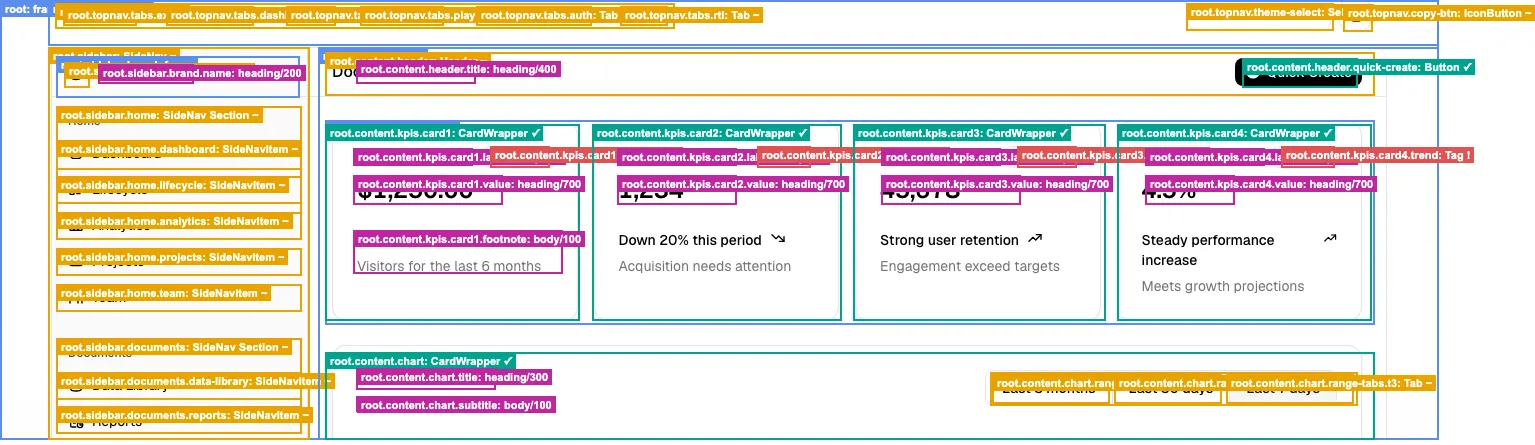
The component matcher breaks a screenshot from another design system into a tree of HubSpot's design-system components, with a match mark on each. I tested about 40 cases, including screens from Stripe, Shopify, Vercel, shadcn, MUI, and Ant Design Pro. Final scores from my own verifier agent: 85 for code, 86 for design-system screenshots, 90 for everything else. View full size: The component matcher's overlay on a dashboard from another design system
Why I archived it
Then I archived it. It worked against Figma’s grain, because inferring a spec from pixels or code is always a guess. Figma Code Connect is the right layer, and that is an org decision.
The handoff study
To make the case, 21 front-end engineers from 11 product areas answered a handoff study. More than half still need Figma for exact values, and on whether a prototype alone is enough the room split evenly.
The full version, with the numbers, is on a private page. Ask me for access.